KATTIE Project
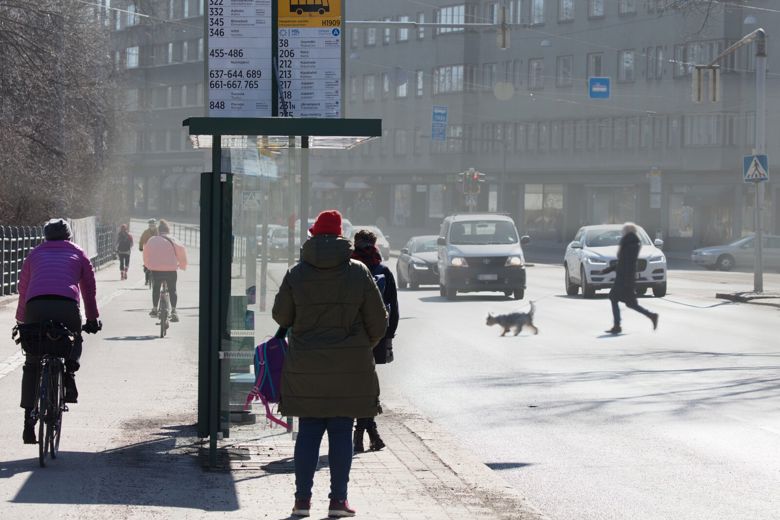
The KATTIE project (Management of Street Dust and Air Quality in Road Environments) investigates factors affecting emissions and concentrations of street dust, as well as the shares of different emission sources in various street and road environments. The project also identifies the most effective measures for reducing street dust and supports their implementation.
The EU’s binding air quality limit values will become significantly stricter in 2030. Concentrations will already be compared with the new limit values during the years 2026–2029. If exceedances of the new limit values are observed during that period, municipalities will be required to draw up an air quality roadmap describing how the limit values will be met by 2030 at the latest. The new daily limit value for thoracic particles (PM10) will be challenging to meet along busy streets and roads due to street dust. New measures and the intensification of existing measures will therefore be needed.
The KATTIE project provides information to support cities’ air quality management and to help meet the street dust related objectives of the National Air Pollution Control Programme 2030. The project continues the development work carried out in earlier street dust projects (KAPU, NASTA, REDUST, KALPA, KATOA).
Within the project, mobile street dust measurements are carried out using the Sniffer mobile laboratory across street and road networks in Helsinki, Vantaa, Espoo, and Kuopio. Some of the measurement routes have been subject to monitoring and intensified street dust control measures since 2006, making it possible to assess emission trends over a period of approximately 20 years. The project also examines the amount of dust load present on roadways and sidewalks at selected sites. Factors influencing street dust emissions are modelled using the Nordic NORTRIP model. In addition, comparative measurements of dust emissions from different tyre types are conducted, and a survey is carried out on the shares of different winter tyre types in the Helsinki metropolitan area and elsewhere in Finland.
The KATTIE project is implemented as a joint research project between several organisations during the years 2025–2026. The main responsibility for implementation lies with the Metropolia University of Applied Sciences and the Finnish Environment Institute (Syke). The project is funded by the cities of Helsinki, Espoo, Vantaa and Kuopio, the Helsinki Region Environmental Services Authority (HSY), the North Savo ELY Centre (from 1 January 2026, Economic Development Centre for Eastern Finland.), as well as Mestar Kuopio Ltd, Savon Kuljetus Ltd and Destia Ltd.