HSY monitors air quality in Järvenpää in 2026
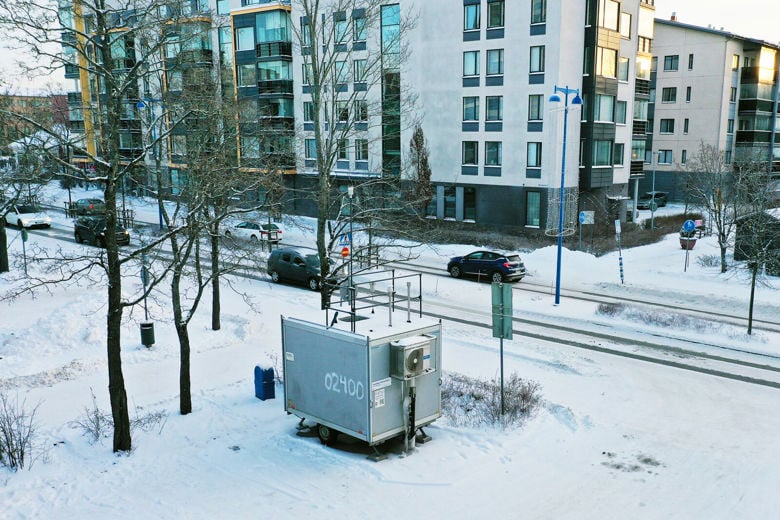
HSY started air quality measurements in Järvenpää city center in January 2026. The monitoring station will collect data especially on the effects of traffic exhaust and street dust on air quality.
Traffic exhaust, street dust, and wood burning occasionally impair air quality in Järvenpää
HSY monitors air quality in Järvenpää city center this year. The monitoring station is located at Helsingintie 4. The purpose is to assess traffic’s impact on air quality in the center.
“Air quality in Järvenpää is generally good. It is occasionally degraded by traffic exhaust, street dust, and wood burning. These emissions are released close to the breathing height,” says HSY air quality expert Outi Väkevä.
Traffic-related air quality issues are greatest near the main streets and the Lahti–Helsinki motorway (Highway 4). There is no industry in Järvenpää that significantly affects air quality.
“The station in the center provides data on exhaust and street dust concentrations at different times. The measurements describe Järvenpää’s air quality but also give insight into trends in busy town centers across Uusimaa,” Väkevä explains.
Actions needed to reduce street dust
Air quality was last measured in Järvenpää center in 2022. At that time, street dust (PM10) levels did not exceed EU limits but did exceed WHO guidelines.
“The new EU Air Quality Directive published at the end of 2024 will significantly tighten current limit values. Stricter limits will require additional measures, for example, to control street dust,” Väkevä says.
Street dust in Järvenpää is reduced through street maintenance.
“We mainly use sanding to prevent slipperiness. Sanding gravel can be removed during snow-free periods or long mild spells in central and busy areas such as Helsingintie and Rantakatu. This helps reduce dust formation,” says Aija Schukov, Construction Manager at the City of Järvenpää.
In spring, when streets are cleaned of sanding gravel, dust is further reduced by high-pressure washing and vacuum sweeping.
Street dust consists mainly of finely ground asphalt and sanding gravel. Studded tires especially wear down asphalt and create dust. Street dust is a major health and comfort issue in cities.
Wood burning worsens air quality in residential areas
HSY monitors the impact of wood burning on air quality annually in various residential areas. In 2025, this was studied in Kyrölä, Järvenpää using small measuring devices. Wood burning produces harmful fine particles and carcinogenic PAH compounds such as benzo(a)pyrene.
“Benzo(a)pyrene levels in Kyrölä were similar to those in other residential areas in the Helsinki metropolitan region. Levels were very low in summer but highest in January and October. Final annual results will be ready in spring,” Väkevä says.
Emissions from wood burning can be reduced by proper burning practices. A simple way is to burn only dry wood and never waste. In 2026, wood burning impacts will be measured in Ahjo, Kerava.
HSY is responsible for monitoring air quality in the Helsinki metropolitan area and Uusimaa. In Uusimaa, air quality is permanently monitored in Lohja. Another station moves annually according to the 2024–2028 monitoring program. In 2027, the station will move from Järvenpää to Hyvinkää.
Current air quality in Uusimaa
Information about Järvenpää station
- Address: Helsingintie 4
- Pollutants measured: PM10, PM2.5, NO₂
- Measurement years: 2026 and 2022 (previously 2015 and 2012 about 200 m from current site)