Ending coal combustion further improved the air quality in the Helsinki metropolitan area in 2025

According to HSY’s measurements, the air quality in the Helsinki metropolitan area was mostly good last year. Air quality improved further after coal combustion ended in spring 2025. However, during the spring street dust season and in autumn when the studded tyre season began, air quality deteriorated to poor on many days due to thoracic. Traffic exhaust, street dust and wood burning have the greatest impact on air quality.
Ending the use of coal further reduced sulfur dioxide concentrations
Helsinki Region Environmental Services HSY has been measuring sulfur dioxide concentrations in the metropolitan area since 1983. Most sulfur dioxide in outdoor air has originated from energy production and emissions from marine traffic. Coal is no longer burned in the region’s energy production, and it used to be the main source of sulfur dioxide.
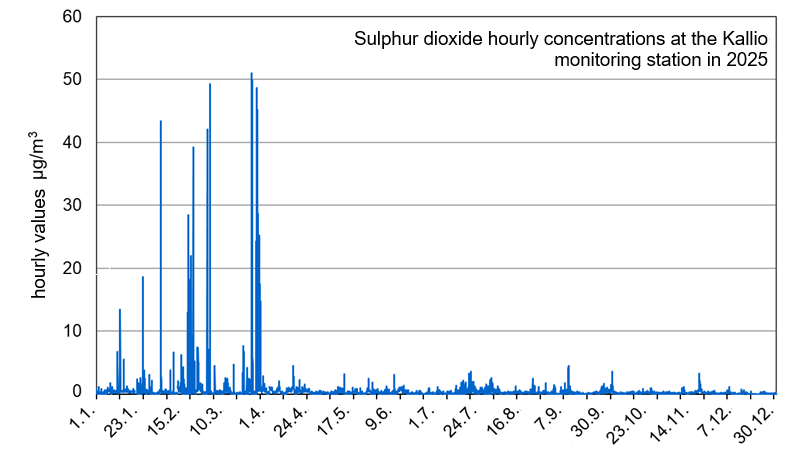
Hourly or daily sulfur dioxide concentrations at the Kallio monitoring station in 2025. Concentrations decreased in spring when coal use was discontinued.
“Sulfur dioxide levels in the metropolitan area fell sharply in the 1980s and early 1990s. In the 2000s, the levels have been low, and last spring ending coal combustion reduced them to almost zero,” says HSY air quality expert Saija Korhonen.
The biggest changes in energy production occurred in the 1980s and 1990s, when flue‑gas desulphurization units were built in power plants, low‑sulfur fuels were adopted, and natural gas use increased. In addition, since the 2000s, the combustion of biomass and municipal waste as well as the use of heat pumps and electric boilers have significantly reduced sulfur dioxide emissions. Sulfur dioxide emission limits for marine traffic were tightened in 2010 and 2015, after which the levels have been very low even in ports.
Street dust may lead to exceedances of the new limit value in busy traffic areas
Renewal of the vehicle fleet and technologies that reduce exhaust emissions have lowered nitrogen dioxide levels from road traffic over the past 30 years. However, road traffic also generates street dust, which impairs air quality especially in spring.
Current limit values for thoracic particles (street dust) are not exceeded in the Helsinki metropolitan area. Under the new air quality directive, the daily limit value for thoracic particles will be tightened, and the maximum allowed number of dusty days will be halved.
“At present, the new limit value would be exceeded in many busy traffic environments. Reducing street dust is essential if we are to stay below the limit by 2030,” emphasizes Hanna Manninen, Head of the Air Quality Unit.
Traffic exhaust emissions, street dust and wood combustion have the greatest impact on the region’s air quality. In 2025, the World Health Organization WHO’s air quality guidelines were widely exceeded, particularly in busy traffic areas. However, concentrations of all measured air pollutants remained below the legal limit values.
HSY’s report on the 2025 air quality in the Helsinki metropolitan area will be published in June 2026.
Information about air pollutants
Sulfur dioxide in outdoor air mainly originates from energy production, ship emissions and oil refining. Sulfur dioxide emissions have decreased significantly in recent decades, and concentrations in outdoor air are now very low.
Nitrogen oxides in the air we breathe come from traffic emissions, particularly from diesel cars and heavy-duty vehicles. Of the nitrogen oxides, nitrogen dioxide causes the most health impacts. At high concentrations it constricts the bronchi and increases respiratory symptoms, especially among children and asthmatics.
Thoracic particles consist mainly of street dust generated by traffic and can be harmful to health. Elevated levels of street dust particularly affect people with respiratory diseases.
Limit values define the maximum permissible health-based concentrations of air pollutants. If a limit value is exceeded, the municipality must prepare and implement air quality plans to reduce concentrations.
The World Health Organization WHO has issued health-based guideline values for air pollutant concentrations. These guidelines are recommendations based on the health effects that air pollutants have been shown to cause.
Read more:
- Real-time air quality: hsy.fi/airquality
- Air pollutant concentration trends
- Air pollutant emission trends in the Helsinki metropolitan area (2025 results to be added in spring)
- Air quality regulation