Air pollutant concentrations decreased in the Helsinki Metropolitan Area – new annual report published
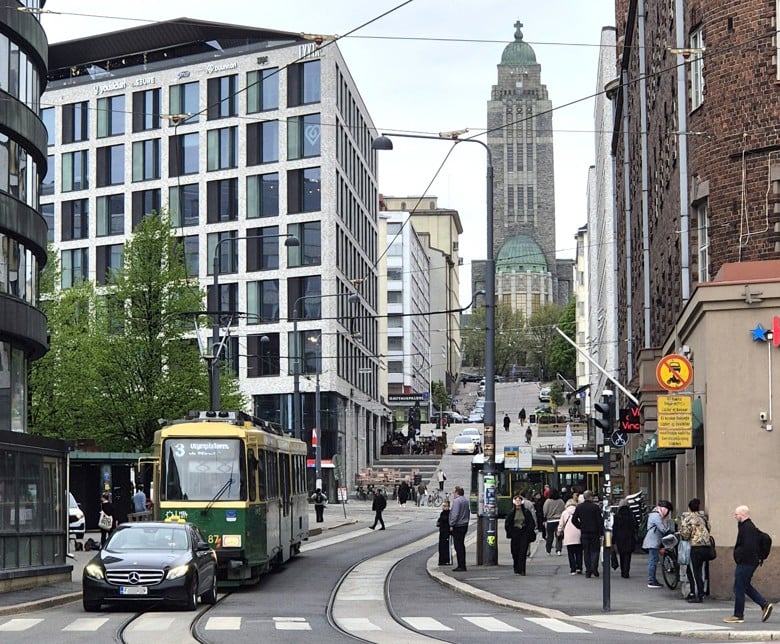
Air quality in the Helsinki Metropolitan Area was mostly good or satisfactory in 2025, according to HSY’s latest air quality report. Concentrations of several air pollutants continued to decline, as in previous years. The new Air Quality Directive sets stricter targets for the quality of the air we breathe. Emissions from street dust and wood burning are decreasing slowly and remain a challenge.
Traffic emissions decreased, but street dust remains a challenge
Last year, air quality impacts caused by traffic exhaust emissions continued to decline in the Helsinki Metropolitan Area.
"Concentrations of exhaust-related nitrogen dioxide decreased at all HSY measurement stations. The electrification of the vehicle fleet and the increasing share of low-emission vehicles are clearly reflected in improved air quality, says our air protection specialist Saija Korhonen."
In addition to exhaust emissions, road traffic generates street dust. Street dust is formed from wear of the road surface by tyres, crushed gritting materials, and tyre and brake wear. Studded tyres wear down asphalt surfaces and produce significantly more street dust than friction tyres.
"Particulate matter, that is street dust, deteriorated air quality especially in busy traffic environments in spring and again at the end of the year when the winter tyre season began. The highest number of dusty days was recorded along Ring III in Viinikkala and in central Helsinki on Teollisuuskatu and Kustaa Vaasa Road, Korhonen explains."
EU limit values for air pollutants have not been exceeded in recent years in the Helsinki Metropolitan Area. However, the World Health Organization (WHO) guideline values are still widely exceeded, particularly for nitrogen dioxide and particulate matter.
Wood burning worsens air quality in residential areas, especially during calm, cold weather
Last year we measured the impacts of residential wood burning on air quality in detached housing areas in Tapanila (Helsinki), Lintuvaara (Espoo) and Päiväkumpu (Vantaa).
"In detached housing areas, wood burning increased concentrations of fine particles and black carbon, especially on calm, cold evenings, when levels rose higher than in busy traffic environments, says Korhonen."
Wood burning also produces benzo(a)pyrene, a polycyclic aromatic hydrocarbon (PAH). The highest concentrations are measured in residential areas during winter months. Last year, concentrations remained below the current EU target value.
"Good wood-burning practices can significantly reduce emissions. Poor combustion produces many times higher emissions compared to efficient burning of dry wood in a good fireplace. Emissions from wood burning have a significant impact on human health because they are generated in residential areas and disperse into local breathing air, Korhonen explains."
New Air Quality Directive tightens requirements and introduces measurements of ultrafine particles
This year, the new EU Air Quality Directive will be transposed into national legislation, significantly tightening current limit values. Stricter limits will require additional measures, especially to control emissions from street dust and wood burning.
"Street dust remains the biggest air quality challenge. To meet the stricter limit values by 2030, measures to reduce street dust must be further intensified, Korhonen notes."
The new directive also introduces measurement obligations for ultrafine particles. These are particles smaller than 100 nanometres, measured as number concentrations in the air. HSY has already carried out indicative measurements at more than 20 different locations.
"The highest annual average number concentrations have been observed near busy ring roads and main access routes, in street canyons lined with high-rise buildings, and near the airport. In ports and nearby areas, emissions from ships, road traffic and machinery increase concentrations. In detached housing areas, concentrations are generally fairly low, Korhonen lists."
There are currently no guidelines or limit values for ultrafine particles. The aim of the new measurement requirement is to improve understanding of their concentrations in different environments, enabling future regulation.
The report Air quality in the Helsinki Metropolitan Area in 2025 is available at:
hsy.fi/ilmanlaatujulkaisut
Information on air pollutants
- Nitrogen oxides in ambient air originate from traffic emissions, especially from diesel cars and heavy-duty vehicles. Among nitrogen oxides, nitrogen dioxide causes the most adverse health effects. At high concentrations, it constricts the airways and increases respiratory symptoms, particularly in children and people with asthma.
- Thoracic particles mainly consist of street dust resuspended by traffic and may harm health. Elevated concentrations of street dust particularly reduce the well-being of people with respiratory diseases.
- Fine particles are mainly generated by traffic exhaust, street dust and emissions from wood burning. In addition, they are transported to the Helsinki Metropolitan Area from sources outside national borders. Fine particles are considered particularly harmful to health because they can penetrate deep into the peripheral parts of the lungs. The most sensitive groups to the health effects of air pollution are young children, older people, and individuals with respiratory and cardiovascular diseases.
- Black carbon (soot) is released into the air through incomplete combustion. The main emission sources in the Helsinki Metropolitan Area are direct exhaust emissions, wood burning in fireplaces, shipping and long-range transport. Harmful organic compounds, such as PAHs, other organic substances and metals, are attached to the surfaces of soot particles emitted in combustion.
- Benzo(a)pyrene belongs to the group of polycyclic aromatic hydrocarbons (PAHs), which are formed during incomplete combustion. Elevated concentrations are found especially in residential areas with extensive small-scale wood burning. Traffic emissions have only a minor impact on PAH concentrations. Benzo(a)pyrene and many other PAHs increase the risk of cancer.
- In addition to the traditional mass concentration, the number concentration of particles is also measured in air. In urban air, the number concentration particularly reflects ultrafine particles originating from nearby exhaust emissions, which can penetrate deep into the respiratory system. The main emission sources in the Helsinki Metropolitan Area are vehicles and machinery, as well as shipping and air traffic.
- Limit values define the maximum acceptable health-based concentrations of air pollutants. If a limit value is exceeded, the municipality must prepare and implement air quality plans to reduce concentrations below the limit.
- The World Health Organization (WHO) guideline values are recommendations for air pollutant concentrations that guide environmental authorities in urban planning and decision-making.
Links:
Air quality now
Burn wood cleanly
Trends in air pollutant concentrations
Open data